




Thrive. For Life.

Thrive. For Life.
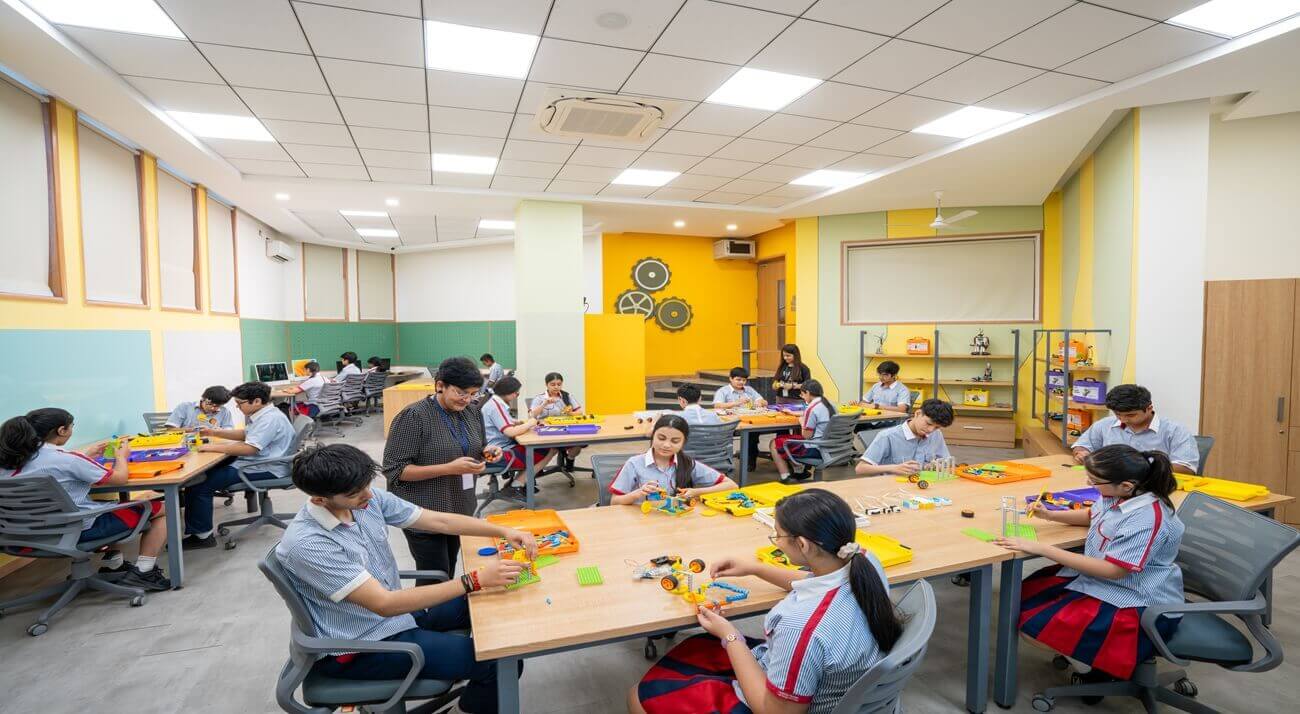
Children naturally ask questions about the world around them. They want to know why things happen, how objects work, and whether there is another way to do something. Schools can build on this natural curiosity by giving students opportunities to explore questions, try ideas, and learn from the results. Curiosity-Driven Learning is not simply about asking questions; it is about helping students find answers and understand what they discover. By encouraging students to think beyond familiar approaches and explore new possibilities, schools can add value like Innovation and help students turn ideas into meaningful outcomes.
This process helps students develop problem-solving skills. They learn to understand a ch0allenge, consider different options, and work towards a solution rather than wait for someone else to provide the answer. For parents comparing a CBSE School in Delhi, it is worth looking at how students are encouraged to apply what they learn, think independently, and approach unfamiliar situations.
Students need more than subject knowledge to solve problems. They also need opportunities to use that knowledge, test their understanding, and learn from the results.
India's National Education Policy 2020 encourages schools to move beyond rote learning and give greater importance to understanding, questioning, discussion, and practical activities. Many reports have examined how classroom activities can help students develop these abilities.
The process can be understood through four simple stages:
| Stage | What students do | What they learn |
|---|---|---|
| Ask | Identify a question or problem | To observe and ask questions |
| Explore | Read, observe, and gather information | To understand the issue |
| Try | Test an idea or possible solution | To apply what they know |
| Review | Look at the results and make changes | To learn from experience |
Students may need to repeat these steps before finding a solution that works. This teaches them that mistakes are part of learning and that a different approach can sometimes lead to a better result.
The way a lesson is taught can influence how students approach a problem. Instead of always giving students the answers, teachers can create opportunities for them to investigate, discuss, and apply what they have learnt.
Regular opportunities to practise these methods help students develop problem-solving skills and become more confident in approaching new challenges.
Problem-solving is not limited to science, mathematics and technology. Creative and physical activities also give students opportunities to express ideas, make decisions and work towards shared goals.
The school recognises arts-integrated and sports-integrated learning as part of a broader approach to education. At GD Goenka, the Flagship School, Vasant Kunj, students have opportunities to engage in visual arts, theatre, music, dance and sports.
These activities can support learning in different ways:
The connection with innovation becomes clearer when students create something, make choices, respond to feedback or find a new way to approach a task. These experiences complement the thinking skills developed through academic learning.
At GD Goenka, The Flagship School, Vasant Kunj, Innovation is reflected in learning experiences that encourage students to question, explore, experiment, and discover new ways of approaching challenges. These examples show how problem-solving can be encouraged at different stages of school education.
The Junior Wing introduces children to concepts through hands-on activities, storytelling, playful numeracy, and environmental exploration.
These experiences give children opportunities to explore ideas from an early age. They also lay the foundation for Curiosity-Driven Learning as students progress through school.
The school's specialist learning spaces help students connect classroom concepts with practical activities.
For example, building a robotic model requires students to understand what it should do, assemble its components, and check whether it works as intended. If something does not work, they need to identify the issue and adjust their approach. Such activities connect classroom knowledge with practical problem-solving.
Finding a solution often requires students to gather information, listen to different viewpoints, and explain their ideas clearly. The school's learning resources and collaborative activities provide opportunities to practise these abilities.
For families considering a CBSE School in Delhi, these examples illustrate how practical learning, research, and collaboration can become part of everyday classroom experiences.
As students progress through school, they encounter questions that may not have one obvious answer. They need to learn how to use their knowledge, find relevant information, consider different viewpoints, and change their approach when necessary.
Teachers support this development by guiding students without solving every problem for them. Giving students room to think, make decisions, and learn from their attempts helps them become more independent and confident learners.
For parents evaluating a CBSE School in Delhi, it is worth looking at whether students have regular opportunities to investigate questions, apply their knowledge, and improve their work. At GD Goenka, The Flagship School, Vasant Kunj, practical learning, technology, research, and activities beyond the classroom contribute to this wider approach to student development.
By making Curiosity-Driven Learning part of everyday education, the school aims to help students develop problem-solving skills and approach new challenges with confidence, creativity, and responsibility.